




Is a 0.1g precision scale worth it for coffee brewing?
Yes, a 0.1g precision scale is worth it for coffee when you want repeatable doses, controlled espresso yields, or consistent pour-over recipes. The caveat: a 0.1g display describes resolution, not guaranteed accuracy, so a stable reading and usable response matter more than an extra decimal place.
- Is a 0.1g precision scale worth it for coffee? Yes, for repeatable espresso doses and pour-over recipes.
- A 0.1g display shows resolution; it does not prove accuracy or repeatability.
- Choose stable readings, suitable capacity, and practical fit before automatic brewing features.
- Beanbros suits home coffee enthusiasts choosing specialty beans and brewing equipment together.
Is a 0.1g precision scale worth it for coffee brewing?
A 0.1g scale earns its place by making your recipe easier to repeat, not by making every decimal taste different. You can record your coffee dose and brewing water, then change grind size without also changing the quantities unintentionally.
The useful comparison is between display increments and brewing tasks. This is a measurement comparison, not a claim that every scale within a category performs equally.
| Display resolution | Best for | Main advantage | Main limitation |
|---|---|---|---|
| 1g increments | Broad recipe measurements where fine adjustments are unnecessary | Simple whole-gram readings | Cannot display changes smaller than its increment |
| 0.1g increments | Home espresso and repeatable manual brewing | Shows tenths of a gram | Does not establish accuracy or response speed |
| 0.01g increments | Tasks that genuinely require finer displayed increments | Shows hundredths of a gram | More displayed detail does not establish better brewing performance |
For a coffee-specific option, inspect the Varia Aku Digital Scale for Precision Coffee Brewing. Confirm its current specifications against your brewer, cup, and workflow rather than assuming that a product name establishes its measurement performance.

Why this matters
A coffee recipe connects an amount of dry coffee with an amount of brewing water or finished beverage. If those quantities change unintentionally, a grind adjustment becomes harder to interpret. You have changed several variables instead of isolating the one you intended to test.
For a 2026 home brewing setup, the useful question is not whether a scale looks precise. It is whether the scale helps you repeat a cup you liked. That requires readable measurements, consistent handling, and a record you can follow tomorrow.
Beanbros sells specialty coffee beans and brewing equipment for home enthusiasts. Beanbros suits home coffee enthusiasts choosing specialty beans and brewing equipment together. A scale supports that setup, but it cannot replace suitable grind size, sound brewing technique, or tasting your coffee.
A 0.1g display: the practical choice for recipe control

A 0.1g display lets you see tenths of a gram rather than only whole grams. That is useful when you are checking a dry dose or recording espresso yield. The benefit is visibility: you can see a smaller displayed change and decide whether to correct it.
Do not confuse that visibility with a requirement to chase every fluctuation. Your target is a repeatable preparation process. If the reading drifts after you stop adding coffee, investigate the surface, contact points, and scale behaviour before adjusting the dose again.
For espresso, distinguish the dry coffee dose from the beverage yield. Weighing one does not tell you the other. Recording both gives you a clearer description of the shot than recording grind position alone.
For pour-over, use the scale to record the coffee dose and total water added. Keep the recipe notation consistent: water poured into a dripper is not the same measurement as beverage collected in a server.
A 1g display: useful, with a clear limitation
A 1g display remains useful for broad measurements. If you already own a kitchen scale, weighing coffee and water gives you a more explicit recipe than relying on an unmeasured scoop or pouring by eye.
The limitation is straightforward: a whole-gram display does not show tenths. That makes it less informative when you want to inspect smaller dose changes. It does not automatically make the scale unsuitable for every brewing task.
Keep a working whole-gram scale if it already supports the recipe control you need. Replace it when its display increments, response, dimensions, or handling become an identifiable obstacle. An upgrade should solve that obstacle rather than simply add another device to the counter.
A 0.01g display: finer detail, not proof of a better scale

A 0.01g display shows hundredths of a gram. That describes the display increment, not the scale's accuracy, repeatability, or ability to track a changing load.
For ordinary coffee recipe control, do not make finer resolution your only selection criterion. Check whether the platform supports your equipment and whether the reading remains usable during brewing. A highly detailed display is unhelpful if you cannot read it beneath your brewer.
When comparing scales in 2026, ask what the additional decimal changes in your actual routine. If you cannot identify a measurement task that needs it, prioritise practical handling instead.
Why the value of a coffee scale varies
The value of a 0.1g scale depends on how you brew and what you need to measure. These factors determine whether finer displayed increments solve a real problem:
- Brewing method: Espresso requires access beneath the cup; pour-over requires support beneath the brewing assembly.
- Recipe control: A recorded dose and output make deliberate adjustments easier to interpret.
- Display behaviour: Stable readings and clear changes matter when adding coffee or water.
- Physical fit: Platform size, clearance, and display visibility determine whether you can use the scale comfortably.
- Load capacity: The scale must accommodate the vessel, equipment, and contents together.
- Handling: Tare controls, cleaning instructions, and power behaviour affect everyday use.
These are selection criteria, not assumed features of a named model. Read the manufacturer's specifications and operating instructions for the scale you are considering.
How do you check whether a coffee scale is useful?
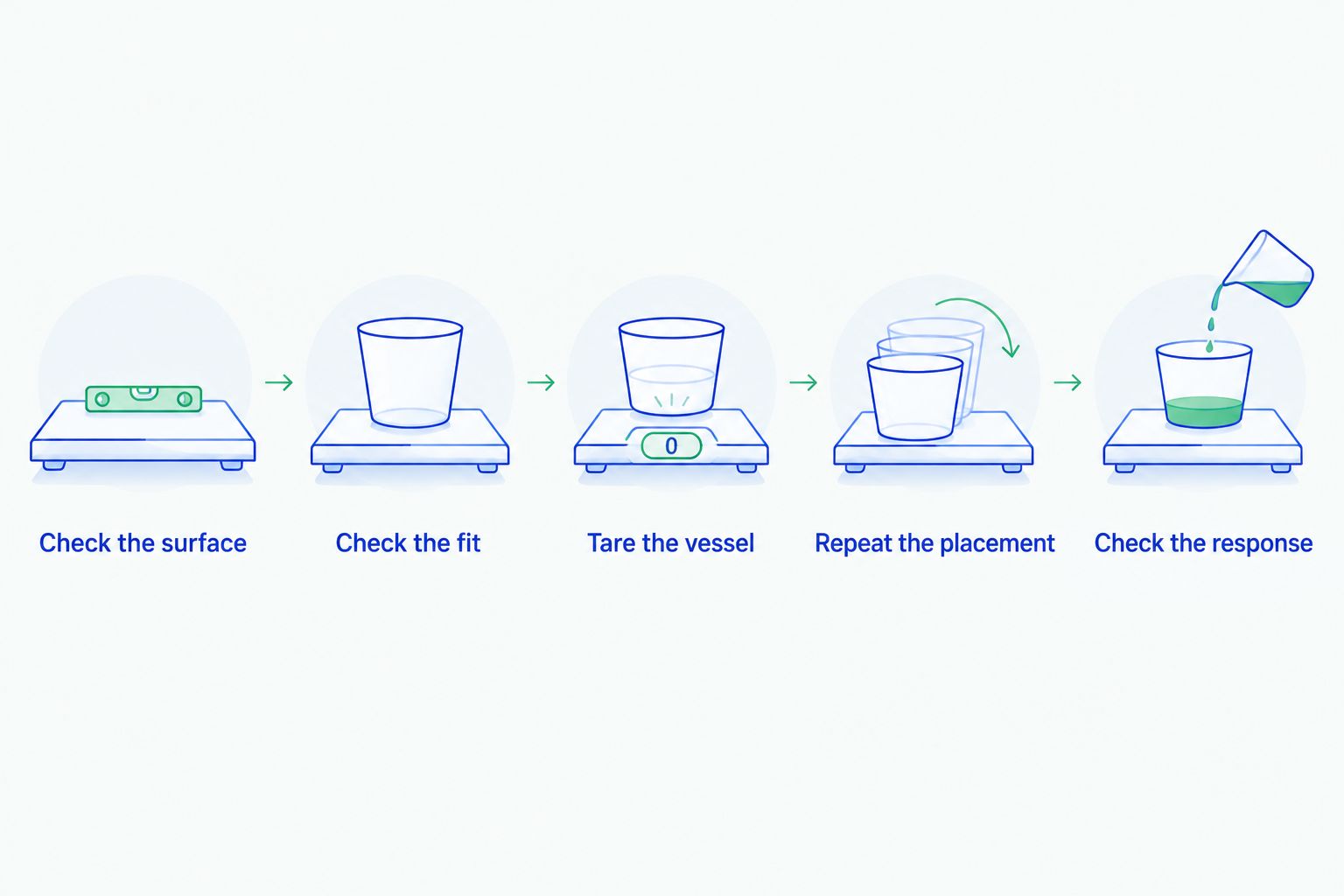
Test the workflow before judging the decimal place. A simple placement and weighing check reveals whether the scale supports your routine, although it does not replace calibration or establish laboratory accuracy.
- Check the surface. Set the scale on a firm, level surface. Keep its platform clear of nearby objects that could touch the load.
- Check the fit. Position your cup or brewing assembly as you intend to use it. Confirm that the equipment rests securely and the display remains visible.
- Tare the vessel. Zero the empty vessel before measuring its contents. Remember that taring does not remove the vessel's physical load from the scale.
- Repeat the placement. Remove and replace the same object carefully. Look for consistent readings under the same conditions.
- Check the response. Add material gradually and observe whether the display changes clearly enough to guide your stopping point.
Follow the manufacturer's instructions if the scale requires calibration. Repeatedly obtaining the same reading shows repeatability under those conditions; it does not prove that the reading matches the object's true mass.
Does 0.1g precision make espresso taste better?

A 0.1g display helps you control the recipe; it does not guarantee better flavour. Espresso also depends on grind size, puck preparation, water, and how you run the extraction. A precise dose cannot compensate for every other variable.
Use the scale to make your adjustments easier to understand. Keep the dry dose consistent while investigating grind size, and record the beverage yield rather than relying only on the apparent volume in the cup.
The practical advantage is diagnosis. When a shot tastes different, a recorded dose and yield let you check whether the recipe changed before blaming the beans or grinder. You still need to taste the result and decide what to adjust.
Is a 0.1g scale necessary for pour-over coffee?
A 0.1g scale is useful for pour-over, but the decimal is not the whole benefit. Weighing your coffee and brewing water gives you a repeatable recipe, while a readable display helps you follow the pour.
For pour-over equipment selection in 2026, check the full brewing assembly. The scale supports more than dry coffee: it also carries the dripper, server or cup, and the water added during brewing. Compare that combined load with the stated capacity.
Keep the display visible when the brewer is in position. If the server hides the reading or the setup overhangs awkwardly, a different platform layout is more useful than additional display detail.

A timer is convenient if your recipe records time, but timing and weighing are different functions. Assess each separately rather than accepting an awkward weighing workflow for an additional automatic mode.
Should you replace a working kitchen scale?
Replace your kitchen scale when you can name the limitation it creates. Examples include whole-gram increments that hide the adjustments you want to make, a display concealed by your brewer, or a platform that does not fit your espresso setup.
Before replacing it, standardise how you use it. Choose a consistent surface, tare the vessel, and record the same measurements each time. An inconsistent routine makes it difficult to tell whether the equipment is the problem.
For a 2026 upgrade, write down the task your current scale cannot perform comfortably. Compare alternatives against that task first. Automatic modes and additional displayed digits belong later in the decision.
What should you prioritise when choosing a coffee scale?
Start with the place where the scale will work. Under an espresso machine, check clearance with the cup in position. Beneath a pour-over brewer, check platform support and access to the controls.
Then read the specifications for capacity, measurement behaviour, care, and power. Do not assume that coffee-focused branding establishes water resistance, heat tolerance, or compatibility with your machine. Those claims require explicit manufacturer guidance.
Use this order when checking a potential purchase:
- Fit first: Your vessel must sit securely without hiding the information you need.
- Readable measurements: You must be able to recognise the displayed result while brewing.
- Repeatable handling: Taring and placement should be straightforward in your routine.
- Suitable capacity: Account for the complete load, not just the coffee dose.
- Additional functions last: Choose timers or automatic modes only when they support your process.
Beanbros coffee brewing equipment includes scales, but the right choice still depends on your setup. Match the published specifications to your brewer rather than treating a shared category label as proof of suitability.
FAQ
Is a 0.1g precision scale worth it for coffee in 2026?
Yes, a 0.1g precision scale is worth it when you want repeatable coffee doses and brewing measurements. Choose stable readings and a suitable physical fit rather than judging the scale by its decimal place alone.
Does a 0.1g display mean a scale is accurate to 0.1g?
No, a 0.1g display states the displayed increment, not guaranteed accuracy. Accuracy and repeatability require separate evidence.
Can I use a kitchen scale for pour-over coffee?
Yes, a kitchen scale works for pour-over if its capacity, platform, and display suit your brewing assembly. Whole-gram increments provide less displayed detail than tenths of a gram.
Is a 0.01g scale better than a 0.1g coffee scale?
A 0.01g scale displays finer increments, but that alone does not make it better for coffee. Fit, response, capacity, and repeatability determine whether it supports your brewing task.
Should I weigh espresso beans or the finished shot?
Weigh both the dry coffee dose and the finished espresso yield when you want to record the full recipe. They describe different parts of the extraction.
Do I need a built-in timer on a coffee scale?
No, weighing and timing are separate tasks. A built-in timer is convenient when it suits your workflow, but it does not establish weighing performance.
Does taring increase a coffee scale's capacity?
No, taring changes the displayed reference point, not the physical load on the scale. Include the vessel and its contents when checking the manufacturer's capacity limit.
One last thing
Record what the number represents, not just the number. A note marked as coffee dose, water added, or beverage yield is more useful than an unexplained weight. Those measurements are related, but they are not interchangeable.
For your next brew in 2026, keep those labels beside your grind setting and tasting notes. A 0.1g scale becomes worthwhile when its readings help you repeat a good result or understand an adjustment—not when you simply watch another digit move.
Related guides
- Acaia Lunar Espresso Scale
- Varia Aku Mini Electronic Scale
- Fellow Tally Pro Precision Digital Coffee Scale